
Why Not Better?
Why Do We Design?
How well designed for growth are the systems that support your production, your learning, and your expertise-sharing?
Grow or Die?
In the corporate race, we either grow or we die. Business development is Job #1.
How do I help businesses win work?
How do I help grow your business and improve your margins? How do I help you Differentiate from your competition?
I ensure that you're good at your "Bigs" today - and help get you ready for tomorrow.
Fix Your Bigs - your most important asset is your people, right? But not the head count, the Head Content! How connected are your "specialty" experts across all of your locations? Are you making it very easy for them to collaborate and synergize, to share their leadership to your organization and to your potential clients. Fully leveraging your collective expertise is a surprinsgly easy lift. A well-planned Push, Pull, and Peer-to-Peer communications and learning strategy can be your biggest Mega-Multiplier.
Prepare for the Future - What technology will be a standard tomorrow? BIM --> Digital Delivery. Do you know that you can very easily streamline your workflows using built-in BIM extensions (Item Types in Bentley, Property Sets in AutoDesk)? Do you know that you can get positive ROI essentially instantaneously? Embrace this broadly now and you will lead in tomorrow's BIM-mandatory industry.
Deliver Better - It is impossible to consistently please clients throughout this BIM/Digital industry revolution without a thorough understanding of an increasing complex design and delivery platform. Project requirements are increasingly fat and their margins consistently lean. Software and Workflow Training is the variable with flexibility in this equation.
Leaner training, effectively shared, drives quality your current and future clients expect and supports healthy project margins.
What are your Bigs?
(60 seconds)
Prepare for the Future
We're at an exciting time in the industry - the biggest revolution since dropping the pencils: Digital Delivery at the DOT level. Integratability as a requirement. Here's the secret: the technology that makes integration possible, Item Types (or Property Sets in the Autodesk ecosystem), can improve your quality and save you money right now. As in, the project you're currently working on now. Item Types and View Display Rules are the technologies that unleash - and tame! - the power of The Big Data Age we're in. Lead now or be left behind.
For BIM-ready Drainage and Utilities you have two platforms: OpenRoads Drainage and InfoDrainage. These are really heavy platforms = high risks in implementation. You WILL want an implementation plan to adopt these beasts. Get help; "winging it" is ruinous.
Stay Lean - But Level Up
Our modern design and delivery platforms are really fat. Training is fat. Projects are lean. How do we resolve this?
First of all, make use of Learning.Bentley.com. It's the standard. It's modular, AND you are likely already paying for it.
Second: find or build lean alternatives or gap-fillers (there are a lot of gaps).
Third: effectively share your customs or "leans" with your full user base.
I can help with all three of these.
- Details
- Category: Services
Services
"If you want to go fast, go alone."
"if you want to go far, go together."
"If you want to ORD, get together."
Do NOT go alone.
The ORD Support Gap = RISK (to budget, to schedule, to reputation)
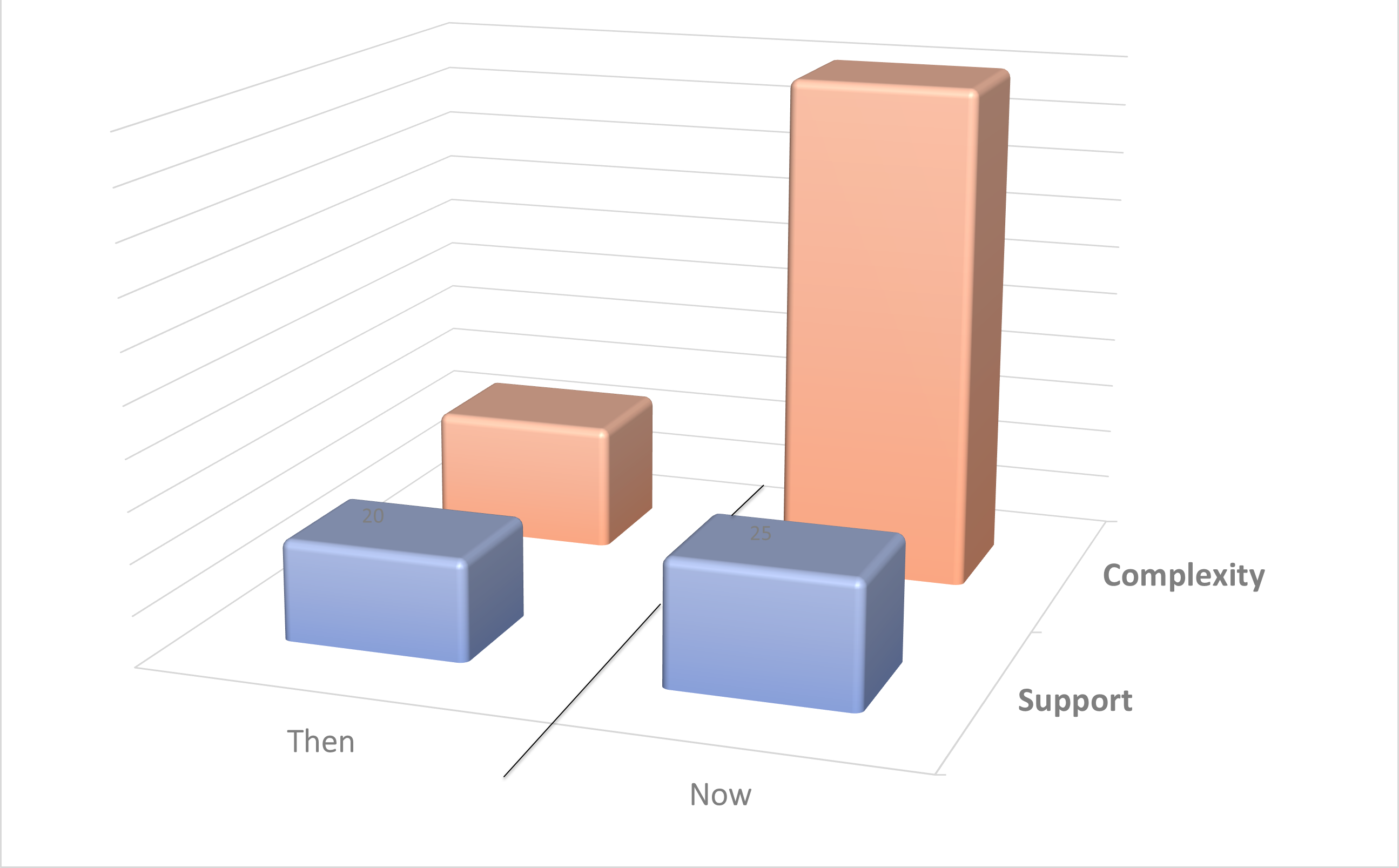
The biggest impediment to success in OpenRoads is its complexity. A BIM/Digital Twin platform - with Design Intent (memory) - is dramatically more complex than a plans production program. The Vendor Support/Training system is arguably better, but not significantly. The gap is huge. How do you bridge it?
Extraordinary Complexity Requires Extraordinary Support.
Whether it's a conversation with your subject matter experts or full-on custom training, we can help. We've been there.
OpenRoads Designer is complex, we can shorten your learning curve and avoid costly mistakes.
At this point, everything we do here at Civil XLr8 is custom. Let's meet YOUR needs. Bentley has free* OnDemand formal training - take advantage of that. We can bridge the gap between general/generic publications and what you need for success.
- ORD Onboarding
- Implementation Planning and Execution - save time and money with Agile Implementation
- OpenRoads Workspace Development and Administration
- Training - live "giant monolith"; periodic short chunks ("modular"). What works for you? I love in-person; remote works well.
- Custom Training Development
- Consulting (General, Strategic, Troubleshooting...)
- Risk Awareness and Mitigation
- Projects Managed via Fast, Lean (but full-featured) Websites
Contact Me Let's save you some time, money, and frustration as you move forward with OpenRoads
- Details
- Category: Services
Live Training Value
One of the first things I do when I start an on-site class is ask:
"Why Am I Here?"
- What value do I add by being here?
- Why did your company pay me money to teach you something that is available for free?
- Videos of these lectures and exercise are availble online. In fact, in many of them, I'm the narrator (unlikely now, but common at the time).
- Why Am I Here?
- It forces staff to spend the time 24, 32 or 40 hours taking the training.
- I can answer "detail" questions and provide context.
- I diagnose, triage, and curate. There is a LOT of content available, some of it is critical to you, much is not. Some has a negative consequence. The first hour I spend focused on learning your needs, picking appropriate foundational material to work through for the first day. Over the course of the day (and the next), I refine my understanding of what you need and then find the best material available. Generally if there is a day 4, I've got some new custom exercise that fill the biggest gap in the material that fits your needs.
- I can translate the generic workflow to how you do things or how you should be doing things for your projects' unique or quirky needs.
- Details
- Category: Training
Agile Implementation
Traditional Implementation

There is a LOT of lost time and opportunity in this approach. And a lot of money spent attempting to anticipate and mitigate all conceivable risks:

Speed it up using Agile techniques:
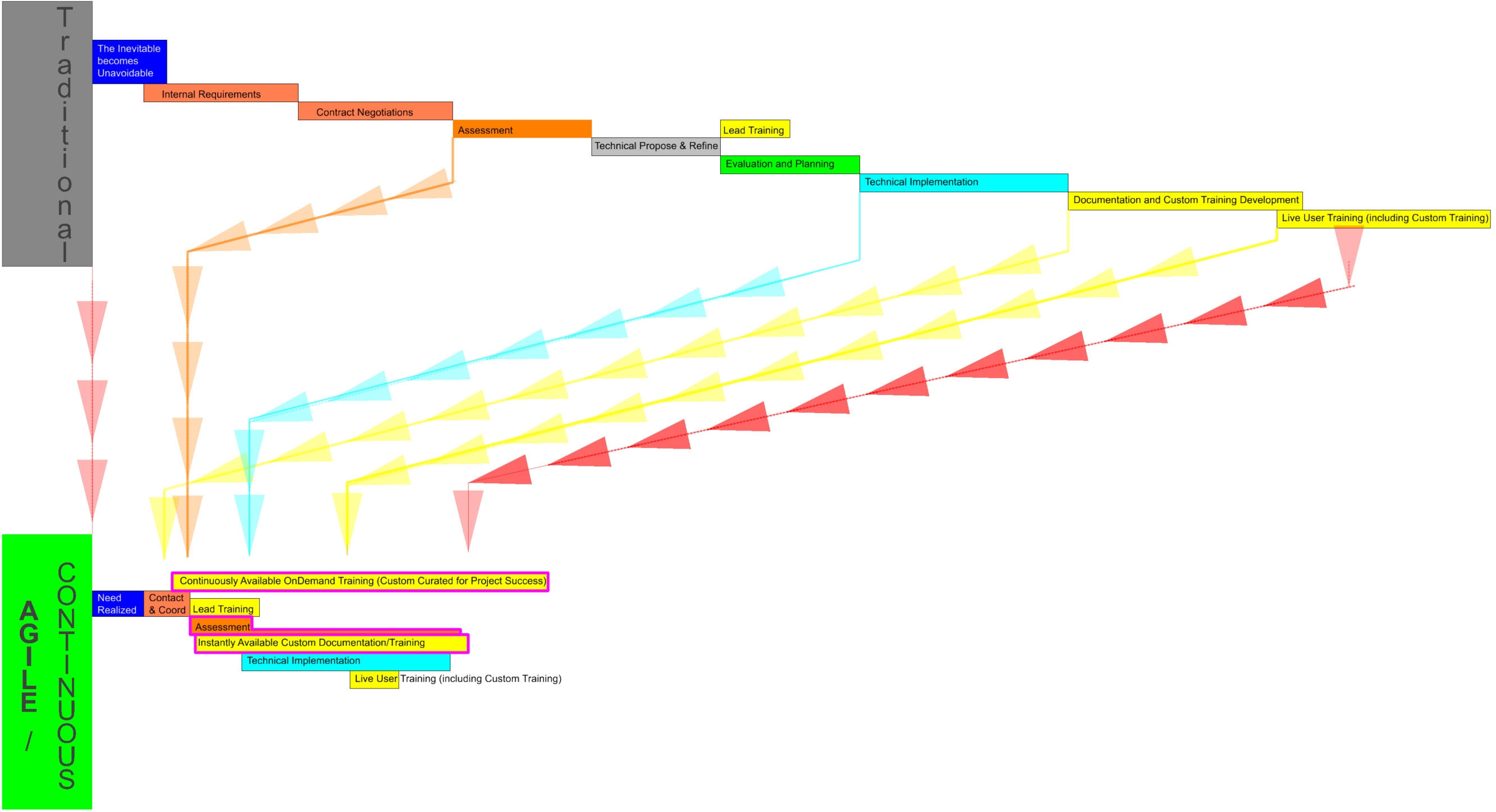
Rather than isolated, exhaustive, delivered-complete phases, Agile Implementation educates and enables user early and continuously. Phases are developed concurrently with a very fast feecback cycle.
- Details
- Category: Implementation
Best Advice: Use all your Support Resources
"If you want to go fast, go alone."
"if you want to go far, go together."
"If you want to ORD, get together."
Do NOT go alone.
Use the resources you have available, all of them.
(For a video read-through of this page: The #1 Best Practice for OpenRoads Success )
Don't try to figure OpenRoads out on your own. Back in the InRoads/GEOPAK days, reverse engineering blew budgets and schedules. The OpenRoads platform is dramatically more complicated, and the risk correspondingly worse.
- Talk to someone who has been through what you're planning to do.
Never wait to get training. Training is available right now. While there is high value in in-person or live training, most of you can get what you need for free right now.
- If you own Bentley software, you likely have access to their LearnServer (learn.bentley.com). Their offerings aren't perfect, but they're in easily-consumable short lean modules. They typically have a downloadable training manual, exercises, and videos of the exercises. They're updated pretty regularly.
- this should be your default training source, unless you have access to customized training.
Twenty five years ago, I authored my take on InRoads and InRoads Drainage training. This time around, I don't see the point. Bentley's LearnServer is my starting point for understanding and keeping current with the software; I recommend it be yours, too.
- There are gaps, and that is my focus as an author and consultant.
YouTube: there's a lot of good content.
Communities: Communities.Bentley.com is your primary support resource. There is good value in their forums and their Knowledgebases (often found via Google search easier than an in-communities search). You can ask questions there, and generally another user will provide answers in a day or two.
Service Ticket: Connect.Bentley.com You pay for Bentley to respond to Service Tickets. They may not resolve your issue, but they're respond to you. Expect a day for someone to ask for more information - so try to be as explicit as possible (dgn's, pictures, step-by-steps, video).
Oh, yeah: Help! I forget that Help is actually helpful nowadays. Its helpfulness was rather unreliable. It's better now. Try help.
Bentley is a business. You pay them for support. Support resources cost them money. They are trying to provide "sufficient" support for as little money as possible - that's how business works. Is it working for you?
If the support is inadequate, express that to Bentley via all the channels you can.
Bentley, like many large organizations, has formal systems of tracking and addressing issues. "If it's not in the system, it doesn't exist". Get it in their system.
- Log problems (via Service Ticket: Connect.Bentley.com) It consumes time, but the fixers respond to noise - in the system. Bugs need to be logged, and the more people logging an issue (and the bigger the organization logging it), the more likely it will be fixed (depending on a dozen other factors).
- Log enhancements. The OpenRoads Ideas Portal is where Bentley tracks enhancements requests. You can "Vote" for existing requests or log your own.
- Bentley polls their accounts as to their level of Satisfaction. Make sure whoever is filling out the survey is aware of your level of satisfaction.
Note: If you pay someone to train you and they don't ensure that you know what your available training and support options are, they are not fully looking out for your best interest. We all want repeat business, but teaching users to help themselves should be Priority #1 for you and your partners and vendors. Anything else is a disservice.
- Details
- Category: ORD Content